20 YEARS OF IACBOX. An achievement worth celebrating!
Even today, 80% of all start-ups fail within the first three years of their founding. Not so the two passionate open-source enthusiasts Anton Strobl and Andreas Eckhart. They set out in 2002, at a time when start-up culture was just beginning to spill over from the US to Europe. Today, they can look back with pride on 20 years of company history, a mature product, and a globally operating enterprise.
An Idea from a Box
Let us begin with the early days of IACBOX. The year was 2002. Portable computers were still rather heavy and affectionately dubbed “luggables”; with the smartest mobile phones, the only thing you could do besides making calls was listen to the radio. The state of Tyrol was a destination for countless vacationers in both summer and winter. Although WiFi had already been around for quite some time, it was only with these devices that demand among guests began to develop. At that time, the two native Tyrolean Oberlanders Anton Strobl and Andreas Eckhart were riding the open-source wave with their business server LXPro and counted hoteliers among their clients. That was the environment from which the brilliant idea would emerge.
On a Friday evening in May, a handful of network engineers were sitting in a bar in Landeck, as they so often did, winding down after a long working week over a few beers. Their shop talk revolved primarily around one central issue: hotels, administrators, and guest WiFi network providers were confronted with new challenges almost daily—massive data consumption, hefty additional billing costs for the hotel industry, bandwidth bottlenecks, and access problems due to static IP addresses were making life difficult for both network providers and users.
Arguably the most brilliant mind in the Friday gathering, Asteas mastermind Anton Strobl, was obsessed with one idea: a remarkably simple software solution for limiting data traffic by time and volume that required no installation whatsoever on the guest device. Discussions grew heated; again and again, Anton sketched his ideas onto various beer coasters, but the round of experts smiled dismissively: “You’ll NEVER get THAT to run!”
Yet the idea would not let Anton Strobl go. On Saturday at 8:00 AM, he sat down at his computer, shut the door, and did not open it again until Sunday at 4:00 AM, when he had finished programming the plug & play engine. The IACBOX was born. At last, the hotel sector—and not only that—had a way to grant guests regulated access to the internet, allocate time and volume quotas, and, if desired, attach a price to it.
Putting the Business Model to the Test
Anton Strobl soon teamed up with Andreas Eckhart and his brother Gerhard. Together, they founded the start-up LSC – Linux Solutions Center, which only later became Asteas Technologies GmbH.
Did you know that 80% of all start-ups fail within the first three years of their founding? The primary reason is the lack of market need for the product. The second reason is an unclear business model and underestimated customer acquisition costs. Another factor lies in a weak management team. And finally, there are plenty of start-ups that simply run out of money. Quite a number of challenges, then, that the founding team and their IACBOX had to withstand. Yet there was still no proof that their product development would actually work in the market.
Unlike many other start-ups, however, success smiled on the IACBOX founding team right from the start. Barely two months after that memorable evening in the Landeck bar, a renowned hotel in Ischgl was secured as their first client. It quickly became clear how precisely the IACBOX met market demands, as the hotel industry was practically clamoring for the product. It was a true problem-solver.
Andreas Eckhart possessed not only profound marketing and sales expertise, but also an exceptionally communicative nature. Thanks to him, the company soon welcomed clients from outside the hospitality industry. New clients, entire industries, and reach far beyond regional borders soon followed.
And the Winner Is…
In addition to market recognition, early awards also helped drive rapid growth and visibility for the IACBOX.
May 14, 2004 was the submission deadline for 10 young enterprises participating in the LANTECH Award. Business plans were quickly refined and backed with figures, as a top-tier jury of experts from business and academia was set to evaluate and select the best entries. Among the submissions were the founders of IACBOX. On June 4, the three best business plans were awarded. Anton Strobl and Andreas Eckhart could hardly believe it when they received the first prize for the IACBOX.
A year later, the Adventure X took place. Anton and Andreas tried their luck once again and submitted an entry. This time, however, they did not hold out much hope. There were no inquiries from the jury for additional documents, nor any preliminary information via phone. Press releases ahead of the premiere spoke of an exceptionally high number of submissions that year. Ultimately, only 11 of them made it to the final round from which the jury selected the winner. When the invitation to the award ceremony arrived at the office, Anton and Andreas decided to travel to Innsbruck to witness the event, despite having little hope of victory.
The award ceremony was held at the ÖBB railway depot. Hundreds of spectators were present as the top three were announced. Third and second place went to other start-ups. Only first place remained. The tension mounted, the room vibrated, resounding applause swept through the hall, and all eyes turned toward them. Even so, it took a moment for Anton and Andreas to realize what was happening: the name “IACBOX” had just sounded over the loudspeakers, naming them as the winning team. Ahead of all the other high-caliber candidates, they had indeed taken first place. Once again, they could hardly believe it. The joy was immense, the after-party legendary, and their pride truly justified.
Years of Growth
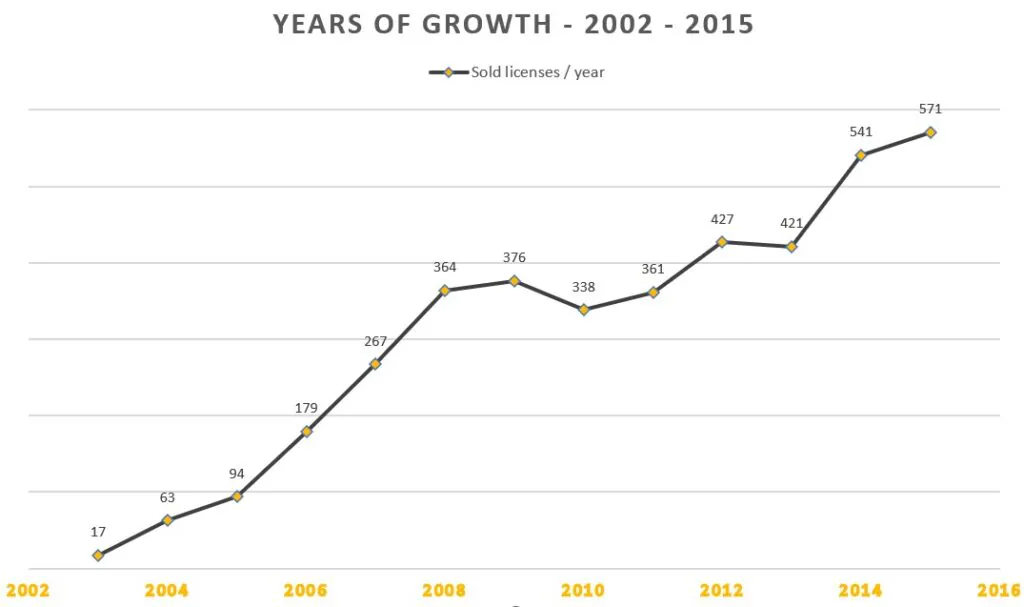
The wave of success did not subside after that; several years of rapid expansion followed immediately. From 17 licenses in 2003, license sales soared, with 571 new IACBOXes sold in 2015. Today, IACBOX enjoys strong sales figures, loyal customers, permanent staff, and a financially sound enterprise that finances itself entirely without external investors or loans.
Although several voices have repeatedly declared WiFi—and with it, the IACBOX—to be obsolete, both continue to enjoy immense popularity. First with DSL, then 2G, followed by 3G, 4G, and now 5G, many believed that cellular networks would replace WiFi—yet nothing of the sort occurred. Both technologies will continue to complement each other for a very long time, as becomes evident whenever WhatsApp waits for a WiFi connection to perform a backup. Cellular networks may provide coverage range, but WiFi delivers throughput. And as global mobility expands across all sectors—whether for leisure, business travel, study, or work assignments—more people than ever will find themselves abroad with a handheld device or wearable in areas not covered by their cellular provider. While regulating data volume was once the primary focus, other priorities have taken center stage today: guest communication, efficient bandwidth distribution, security considerations, regulatory compliance, and granular permissions for different user groups.
In any case, the founders have every reason to stay committed to the product and remain true to their original vision. This down-to-earth approach is clearly evident across all facets of Asteas Technologies, from its beginnings to the present day.
To all our users, resellers, clients, and operators out there, we can say with complete confidence: the IACBOX is here to stay!
We are #iacboxfamily