WiFi in the age of 5G – flop or top?
Fiber optic in every home, 5G at every milk churn, fast internet for everyone beamed down from space – it sounds like something out of the future, yet according to bold announcements in the press and in advertising, this new era has long since arrived. A brief reality check on the state of HSIA.
The COVID-19 crisis has made it clear to us, well beyond healthcare and social systems, that limits do exist. In our consumer society – thanks to just-in-time delivery and real-time supply chains – we have long since grown unaccustomed to waiting. An empty shelf in the supermarket immediately draws uncomfortable attention and can even trigger panic buying. Now the race for available vaccines is underway, and the whole world is feeling the effects of shortages and bottlenecks.
Something similar in terms of resources and availability is happening on the internet as well. During the first lockdown period in Europe, online meeting platforms saw no other option than to temporarily throttle or even disable video conferencing, as half the world was working from home and the limits of possible data throughput were being pushed to the max.
As in many other areas, what the pandemic has exposed is just the tip of the iceberg. Bandwidth bottlenecks are not solely due to crisis mode and the shift of large parts of business life to online channels, but above all to the unbroken trend that is relentlessly bringing more and more people, devices, and data-intensive services online.
While the expansion of mobile data networks in particular is being heavily celebrated in media advertising, there are still gaps to close – and we’re not even talking about 5G yet. In Germany, LTE is currently the standard, which, strictly speaking, represents a kind of 3.9G, since not all requirements of the 4G standard are met. Accordingly, mobile phones display either LTE (iOS) or 4G/LTE (Android).
So before we’re all cruising around on 5G networks, this year the 3G network will first be shut down. What this means for owners of older phones or contracts in Germany can be read here . An interesting look into the hurdles of 5G rollout “in its teenage phase” is offered here : from sluggish frequency auctions to high costs and “fake 5G.”
In Austria, a comparison platform examined data transfer speeds at various points during the lockdown periods and found that the LTE network in particular experienced the greatest fluctuations during the COVID-19 crisis – the diagnosis was up to 40% slower. Cable networks fluctuated less in speed, but at an average of 81 Mbit/s still fell well short of the 100Fast Ethernet standard from 1995.
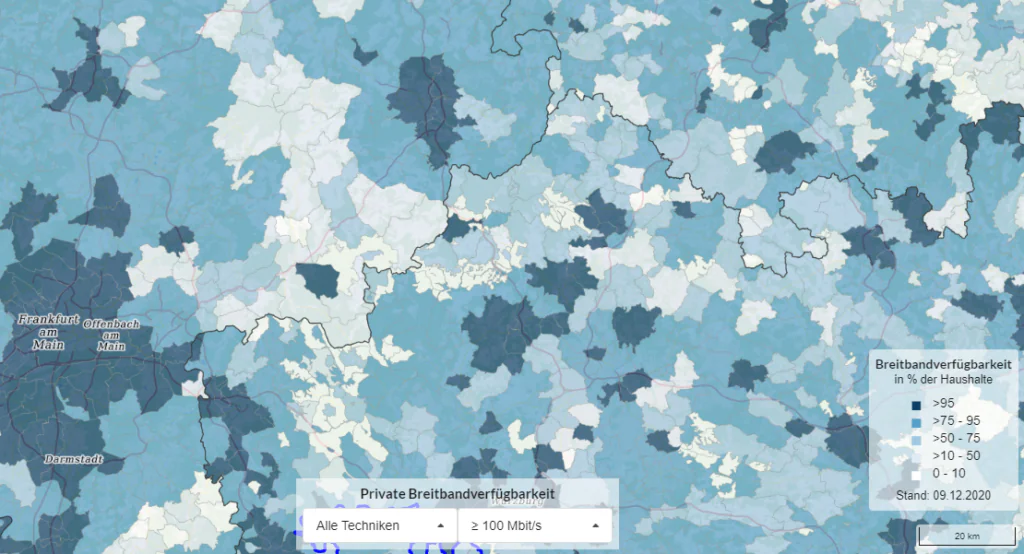
Even in a highly industrialized country like Germany, the availability of broadband internet is still quite uneven, as you can clearly see on the map at this link. Click through, zoom in, and see how rural areas, even in the immediate vicinity of major cities, still look like a patchwork.
It’s no wonder that many manufacturers of standard software or apps now only perform their backups when there’s an active WiFi connection, and prefer to update their systems this way, since higher throughput rates are possible. Accordingly, the WiFi portal remains highly significant when it comes to providing not only guests but also citizens, students, university students, patients, and employees with straightforward, high-performance access to fast internet.