The data and me.
In our new series The data, the cloud, WiFi and me we discuss options. We still have time to think carefully about what should happen with the flood of data that needs to be stored and managed. Yet for far too many companies, managers and individuals, data management is still an annoying task that is best outsourced or left to the IT department or the major players in the IT industry.
This is the first post in this series.
It all began with a great dream of humankind. Even the encyclopedists and some princes and archdukes of the 18th century strove to “convey humanity’s knowledge to the people in France, Austria and Germany”, in the form of art collections, “cabinets of curiosities”, or alphabetically ordered text articles. This dream continues to this day. In the early days of the internet, it motivated the people behind Wikipedia, the Internet Archive, Google and many others. By now, the approach is somewhat more global: it is about universal access to knowledge or, as Google puts it, “to organize the world’s information and make it universally accessible and useful”.
What could possibly go wrong when the educated elite of one of the world’s leading nations pursues such a noble goal? Murphy’s Law has an answer for us: If something can go wrong, it will go wrong.
For almost two decades, we have been eagerly and happily using all these great messaging, search, navigation and analytics tools. And we eagerly await the next achievement that, starting from the valley, conquers every country on this planet where the internet is free enough to spread it. From the very beginning, there was criticism—not only from notorious conspiracy theorists. IT insiders in particular, but also sensible, forward-looking people from other industries, like to warn and quote an old but wise saying: If something sounds too good to be true, it probably is.
In 2006, when Google’s first browser toolbar was announced and promoted for installation on virtually every home PC in the world, there was the first loud outcry from industry experts and competitors. It received some media attention, and from that moment on, the question “Who owns the data and who is allowed to use it” would keep us permanently occupied in its various facets.
When, at the end of 2010, some interesting insights disappeared from the free version of Google Analytics, we could not claim we had not been warned. In 2011, the premium version was proudly presented—price: US$150,000/year. Google has since introduced the Analytics 360 Suite, and 150,000 per year is only the starting price for the simplest version.
Over the past decade, the data business has developed into a multi-billion-dollar industry. The companies with the best, most user-friendly, most widely used—and, mind you, free—information and communication tools on the market are the big winners in this game. While they are now reaping what they have sown, the rest of us are beginning to realize that we are being sold what we gave away for free. In fairness, it must not be forgotten how complex the development of such software products is, and how much technical competence, years of expertise, and intellectual and material resources are required. Why would anyone do that for free? What is wrong with them now making a lot of money from it?
Let us return to the initial question of what can go wrong. In answering it, we combine Murphy’s Law with a well-known saying from the late 16th century, often attributed to Sir Francis Bacon: “Knowledge is power.” Now we come to the crux of the matter: Whoever controls large amounts of data is able to predict human behavior and possibly influence it.
Recent data breaches and incidents on the scale of the Facebook–Cambridge Analytica scandal have prompted governments and companies to call for more legally regulated data protection. Yet even with the now expanded regulations such as the EU’s GDPR and similar laws in other countries, authorities seem to be fighting a losing battle. Every day, more data is generated faster than we can regulate. Only the largest key players in the market have the financial and human resources to keep up with the pace—governments and individuals usually do not.
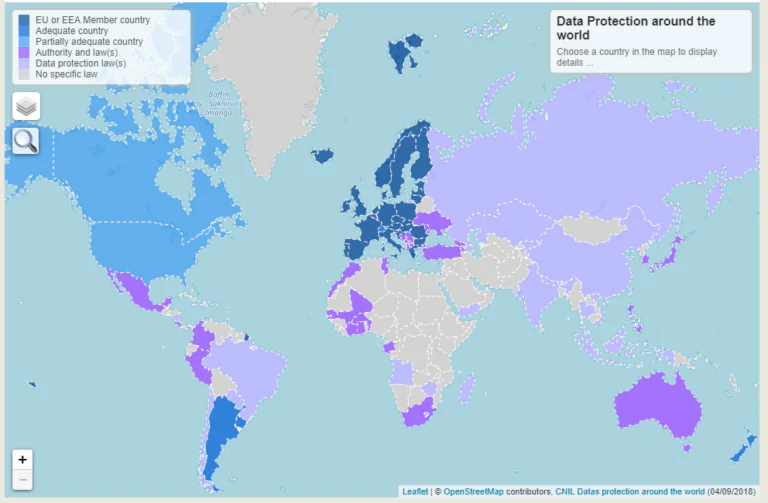
So what should we do? Let us set aside debates about envy and tax fairness as well as doomsday scenarios of all kinds, and look at the matter soberly. Two key factors emerge that are worth considering:
- The challenge is scale: It is not the data itself that brings some big money and many a risk, but rather its sheer volume and centralized analysis. The data of an average person is rarely traded for more than 50 cents. Even the craziest hacker would hardly write code to steal individual bits of data.
By the way: If you are interested in how much your personal data is actually worth, take a look at this interesting calculator. - The challenge is structure: Any outsourced centralized structure for data storage, exchange or analysis is grist to the mill for the big players and increases the likelihood and potential damage of possible data breaches, as well as the attractiveness of attacks or manipulation, many times over. Here, too, we have a saying at hand: Opportunity makes thieves.
Another interesting question is: Do we always need big data to produce meaningful analyses? Clearly not. Using globally collected data to track down the flu virus that is most likely to spread pandemically this winter certainly makes sense. If, on the other hand, the goal is to find suitable sales channels for a niche product in a regional market, global data can be useless and may even cause harm.
This immediately leads to the next question: Can big data or specific data that I have collected myself help me, my family or my company improve my life or my success? It depends. Data needs to be interpreted. Private or business success does not depend on data, but on decisions. Today, there are many ways to collect and consult data as a basis for decisions. However, for a good, data-driven decision, the amount of data alone is completely useless if we cannot read it. We need the right data and the right understanding for the analysis. And we need differentiated, suitable structures for different types of data. For some, it makes sense to centralize or outsource them; for others, it does not.
It is absolutely welcome that governments, companies and individuals are beginning to take the topic of data more seriously. However, instead of focusing only on complying with consumer protection provisions, every company should also understand the potential and value of its own collected data. Instead of routinely handing control of the data generated to the IT department or external services, conscious handling and critical competence should be demanded and promoted internally at all management levels. Informed critical thinking must be cultivated from early childhood throughout the curriculum and throughout professional life. Data-aware yet skeptical decision-makers will be one of the key factors for future success. The ability to distinguish between different types of data and to manage, analyze and use them appropriately for decisions should be a core competence in every modern company.