Pandemic vs. Customer Relationship – Or Vice Versa.
How long is too long? Just as we were looking forward to spring with optimism, news reports are already rolling in about lockdown extensions and tighter anti-COVID-19 measures once again. Yes, of course, the health of employees, customers, guests, friends, family, and not least our own is an asset worthy of the utmost protection.
Yet restaurateurs among us, customer advisors, hoteliers, project and team managers, and executives from middle management all the way to the top have now been living for quite some time with restricted opportunities to meet with one another and with others. As creative and digital as we all become to keep business going, as much optimism as we strive to radiate – morale suffers, there is no denying it.
Social beings like us have not only physical but also basic psychological needs upon which our well-being and motivation directly depend. Drawing broadly on Deci and Ryan, these can be broken down into three concepts:
– Autonomy: a sense of control over one’s own life
– Competence: feeling capable of mastering tasks
– Relatedness: a sense of belonging, a social connection to others
The first two are served comparatively well by the modern online world (though much can be learned from the gaming industry, which is certainly worth an article in its own right). The third point represents the traditional habitat of communication and social media.
Currently, what is likely the largest field study of all time is underway to see how far these needs can genuinely be satisfied online, and we see all too clearly where the friction lies. Today and here, it is primarily about the third need: social connection. The shortcomings in this regard are obvious. In business life, this manifests particularly in one area:
Informal meetings: Anything with a concrete purpose and a clear objective still works reasonably well. But the social exchange, human-level pleasantries, and the many small rituals on the stairs, in the elevator, in the break room, at trade shows, or at conferences are falling away. Not to mention larger team meetings, company outings, in-house exhibitions, anniversaries, etc.
A friendly smile, a handshake, clear social cues during greetings – all of that is history. Behind a mask, it is difficult to perceive someone’s demeanor toward us, leading to uncertainty that, in the worst cases, tilts into an irritable baseline mood.
How can this be addressed when we are expected to avoid direct, personal contact as much as possible, when mask mandates are in place virtually everywhere, and phone calls and web meetings are the order of the day? It is time for a few practical tips:
1. Leverage your interfaces.
We are employing a metaphor here, as interpersonal aspects often receive less than their due attention in our tech-heavy industry.
At the user interface, technology meets people; at the customer touchpoint, the customer meets the provider. These are critical touchpoints; indeed, they should be a matter for executive leadership. Yet we are nowhere near that point. In an alarming number of medium-sized companies, “IT” handles how this looks. After all, we pay for XY CRM software that ensures efficient communication, and social media marketing is something for the intern, right? WRONG.
Even in large corporations, where agencies or entire departments deliver professional corporate and customer communication, it often becomes apparent how starkly the communicated image diverges from lived reality. As medium-sized businesses, we should capitalize on the advantage of being relatively agile and transparent. Communication is a matter for executive leadership.
Comb through your website, update your blog, and visit your corporate profiles across social media. Check where a message can be placed that connects you with customers and business partners during pandemic times: stories, current updates, descriptions, profile pictures, status updates – all these features should not be viewed as static and left unchanged year-round. Share your message more frequently and relate it to current topics that move everyone. Oh, and consider your email signature as well – here are a few ideas for that.
2. Send messages that connect.
Who do you mean when referring to “WE” on your website or company profile? The “we” reference can be defined narrowly or broadly. Handle this consciously. If you are referring only to your company, make that clear: “We at system integrator XY” or “we at Sample Company”.
Show solidarity with customers and business partners through an extended “we” reference: “In our industry…”, “We all want satisfied guests…”, “together we will achieve…”.
In this context, optimism never hurts, as we all need a ray of hope in times like these: “…together we will overcome this hurdle as well”, “…we continue to stand together”, “despite XY, we remain here for you…”.

3. Communicate that you are there – as well as when and how.
There is widespread uncertainty; no one really knows anymore what is open when, where, and for how long, whether in-person visits are permitted, whether an appointment can be booked, an online meeting requested, etc.
Make this clear for your customers. Update your opening hours on Google and make reference to COVID-19 measures so customers can rely on the information. Update your on-hold telephone messaging, and place a sign on the door in addition to officially mandated notices, featuring clear instructions on when and how customers can attend an appointment. Place this information across all company profiles, the website, and the email signatures of all customer-facing staff.
And YES: such information also belongs on the guest WiFi login page (we thought you would never ask).
4. Communicate iconically.
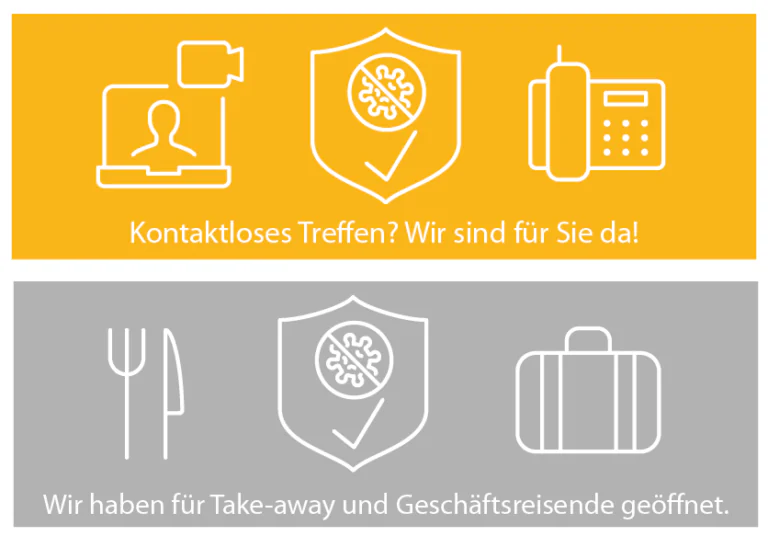
Icons cannot do everything, and some content is simply too complex for pictograms. However, users’ attention spans in digital media are becoming increasingly shorter. Images are far faster than words. Especially when the entire world is focused on a few specific topics, targeted images are impossible to overlook. Icons simplify the message even further; put them to use.
To give you a helping hand, we have designed several attractive banners that are available for immediate download in the my.iacbox portal. You are welcome to use them, customize them, and pass them along to your customers as you see fit.
After all, we are working together to inspire our customers, and united we will navigate this challenging period more easily.