EU Funding Pool
EU Funding Pool: €120 Million for 8,000 New WiFi Hotspots – Down to the Smallest Village
As part of its EU 2020 strategy, the EU is pursuing the so-called Digital Agenda for the European Single Market, aiming to create an economic area among member states focused primarily on digital technology and telecommunications. The main goal of the entire program is for the European digital economy to catch up with the far more advanced economies of the USA, Japan, and South Korea in this regard. To achieve this, 28 separate digital markets are to be replaced by one large single market.
In addition to major programs promoting digitalization and expanding digital networks, the Commission has launched an initiative for nationwide coverage to ensure that more citizens benefit from network expansion, regardless of where they live or how much they earn.
What is being funded?
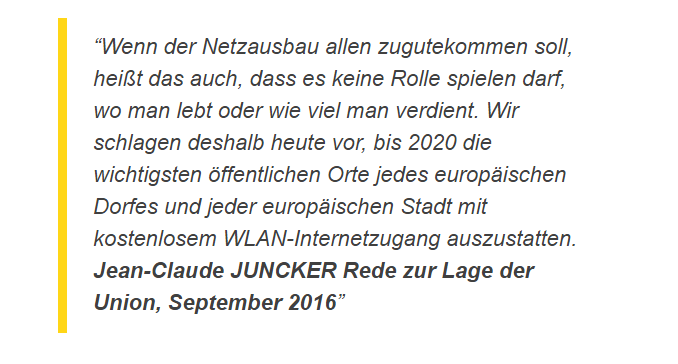
According to Commission President Jean-Claude Juncker, WiFi4EU aims to provide EU citizens with free access to fast internet, down to the smallest village – ad-free and hassle-free, via WiFi hotspots accessible after a one-time registration on a portal. On September 12, 2017, the EU Parliament gave the green light, and the program’s funding of €120 million has been officially approved.
Who is eligible for funding?
Everyone in the European Union
WiFi4EU is intended to be rolled out as broadly as possible, so that residents and visitors of thousands of municipalities (at least 6,000 to 8,000 by 2020) across the EU gain access to high-performance internet connections.
Local public bodies
Public bodies can participate in the initiative, such as municipal administrations, libraries, or health centers. WiFi4EU covers the initial setup costs (such as internet access points, switches, software infrastructure, etc.), while the public body pays for the network connection and maintenance for at least three years.
How is it funded?
Municipalities or other local public bodies apply via the WiFi4EU portal once access opens. The application process is designed to give priority to applicants from small, structurally weak municipalities that currently lack adequate free internet access, and to ensure a fair distribution of funds.
Applicants are free to choose the company that will provide the infrastructure and, upon approval, receive a voucher. This voucher is then passed on to the supplying company, which submits it to the EU Commission, which in turn settles the invoice.
When is it funded?
No time to lose!
Anyone wanting to secure funding needs to stay on top of things, as there is still no fixed start date. The application period has not yet begun; according to the latest information, the first approvals are expected to be granted in early 2018. However, every applicant is well advised to prepare soon, as it cannot be ruled out that the so-called first-come, first-served principle will become the deciding factor, with the faster applicant receiving approval.
Stay up to date with the official website for the funding program: https://ec.europa.eu/digital-single-market/en/wifi4eu-kostenloses-wlan-fur-alle